For anyone whose longest trip is a flat two miles to the shops and back, on a bike that sits in the garage between errands
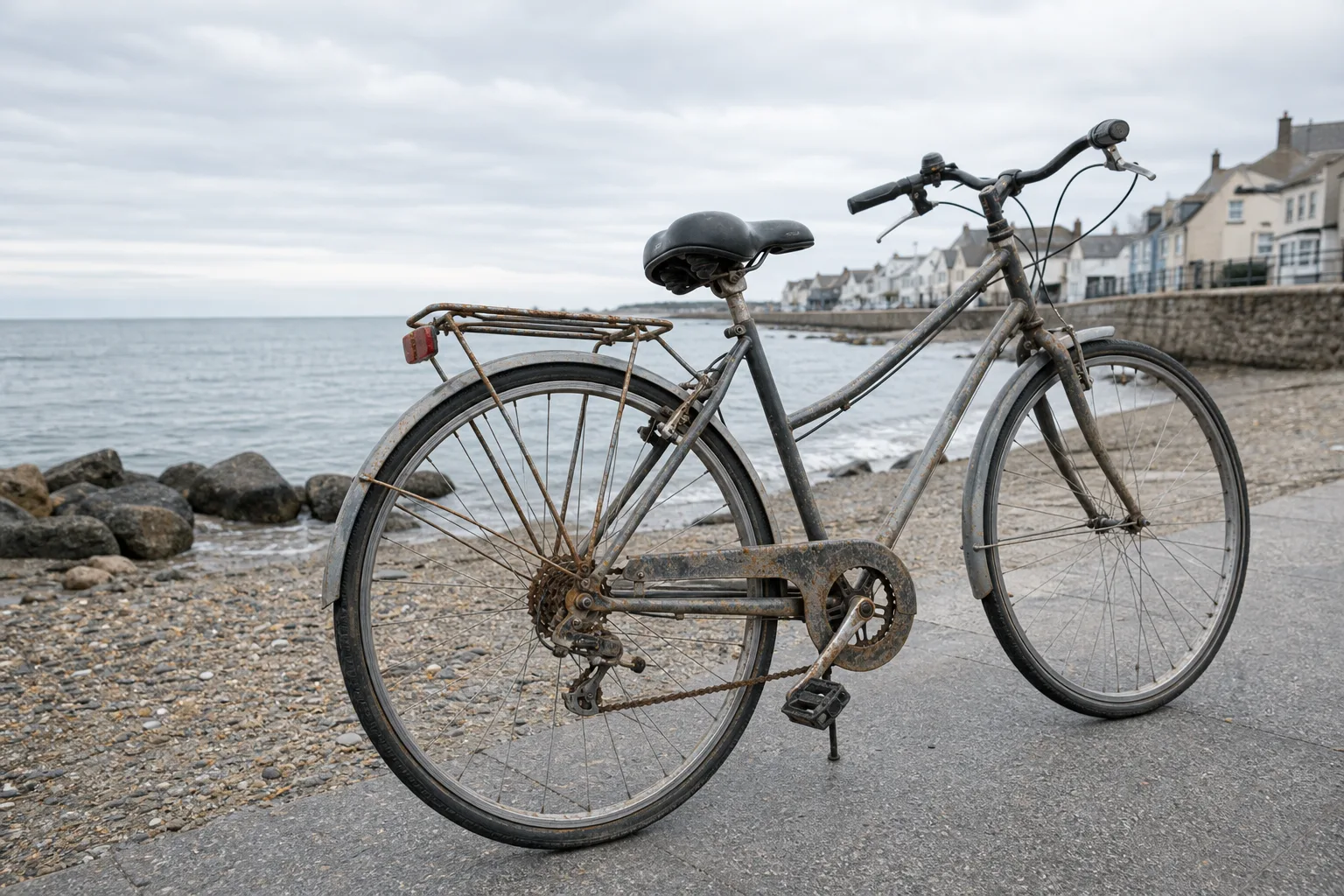
Riding near salt air? What rusts first, and how to check before you buy
Common questions
Hidden cable corrosion
Cables rust inside the housing where you cannot see them, so the first symptom is a stiff shifter or a brake lever that feels vague. Stainless inner wires and sealed housing ends delay this considerably.
Spoke nipples seize
Plated steel nipples fuse to the spoke threads after enough salt exposure, which means a wheel that goes out of true cannot be trued again. Brass nipples cost slightly more and stay workable much longer.
Steel rusts at chips
A painted steel frame corrodes where the coating is broken, typically the down tube, the seat clamp area and the inside of the seat tube. Touching up chips promptly costs almost nothing.
Aluminum forms a dull gray oxide layer that largely protects the metal underneath, but it pits where salt sits in one place. It also corrodes at contact points with steel bolts.
A bike stored three blocks from the water lives a different life than the same model in a dry garage inland, and the difference shows up first in parts nobody looks at on the showroom floor. Frame material gets most of the attention in shop conversations, partly because it is the easiest thing to name and price. It matters less than the chain, the cables, the spoke nipples and the sealed bearings, all of which corrode faster and cost more to replace as a share of what the bike is worth.
What the two frame materials actually do differently
Steel rusts and aluminum does not, in the ordinary sense, but that sentence hides more than it explains. A modern steel frame is painted inside and out, and the tubes are sealed, so corrosion starts where the paint is broken: chips on the down tube, the seat tube clamp area, the inside of the seat tube where a post has been in and out. Aluminum oxidizes into a dull gray skin that mostly protects what is underneath, though it pits badly where salt sits against bare metal, and it corrodes aggressively where it touches steel bolts.
Ride feel splits along predictable lines at the price points that matter for short, flat riding. A steel comfort frame with a long wheelbase absorbs the small sharp hits from expansion joints and packed sand better than a comparable aluminum frame, which transmits more of that chatter into the saddle and grips. Aluminum saves perhaps a couple of pounds on an otherwise identical build, which is worth something if the bike gets carried up steps, and worth nearly nothing if it lives on a porch.
The parts that fail before the frame does
Order of failure is remarkably consistent near the coast. The chain goes first, sometimes within a single humid season if it is never wiped, and a seized link makes the whole drivetrain feel notchy long before it snaps. Cables go next, corroding inside the housing where nothing is visible, so the shifter gets stiff and the brake lever loses its snap. Then spoke nipples, which are often brass on better wheels and plated steel on cheap ones, and which weld themselves to the spoke so the wheel cannot be trued.
Bearings are the slow one. Cup-and-cone hubs and headsets with loose balls admit salt-laden moisture through their seals, and by the time the steering feels gritty the races are already pitted. Sealed cartridge bearings in the bottom bracket and hubs resist this considerably better, and they are replaceable as units, which turns a wheel-rebuilding problem into a twenty-minute job. The Consumer Product Safety Commission is responsible for bicycle safety requirements in the United States, and brake function is squarely among the things worth keeping honest.
What a careful reader checks in the shop
Pick the bike up by the saddle and spin the rear wheel, listening for a dry rasp rather than a hush. Turn the handlebars slowly through their full arc, feeling for the faint click of an indexed headset, which means the bike has already lived somewhere damp. Look at the spoke nipples for a bloom of rust at the rim bed, and look inside the chainstay near the dropout, where road spray collects and paint is thinnest. Ask whether the cables are stainless and whether the housing is sealed at both ends.
Fasteners tell you what the manufacturer thought about. Stainless bolts at the rack mounts, the fender eyelets and the brake calipers cost pennies more and save an hour of drilling out a rounded head. Aluminum rims with machined braking surfaces stay serviceable; steel rims rust, and they brake poorly when wet, which is the wrong combination on packed sand. A stainless or aluminum seatpost with a thin film of grease at the frame junction will still come out in three years, and a bare steel one very often will not.
Storage and the ten minutes that decide everything
Rinsing with fresh water after a beach ride does more than any coating, because salt is only destructive while it sits. Wipe the chain dry, then run a wet lubricant rather than a dry wax one, since coastal air keeps washing the light stuff off. Store the bike inside if there is any way to do it, and if there is not, keep it off the ground and out of a sealed cover, which traps moisture against the tubes. Grease the seatpost and the pedal threads once a year.
Either frame material will outlast the components on it if the bike gets rinsed and lubricated on any consistent schedule, which makes the real choice a question of ride comfort and weight rather than survival. Buy the frame that feels better on the route you actually ride, then spend the attention on the chain, the cables and the bearings.